Fibre Intake Calculator
This Fibre Intake Calculator tells you how much dietary fibre you should be eating each day according to Australian NHMRC guidelines. Most Australians don't get enough fibre - the average intake is just 20-25g when the recommended target is 25-30g per day. Enter your details to see your personalised target and discover the best high-fibre foods to include in your diet.
Enter your details
Average Australian adult eats ~20-22g/day
Your Fibre Intake Assessment
ExampleExample figures, not your own. Worked for a 35 year old woman eating 18 g of fibre a day. Enter your own details and press Calculate.
Daily Target
25g/day
NHMRC Adequate Intake
Your Intake
18g/day
Below targetGap to Close
7g/day
Extra fibre neededHow It Works
The calculator uses Australian NHMRC Adequate Intake (AI) values for dietary fibre, which vary by age and gender. Adult men need 30g/day and adult women need 25g/day. Children's requirements increase with age, from 14g/day for toddlers to 28g/day for teenage boys. Your current estimated intake is compared against your target to show whether you're meeting recommendations.
How to use it
- 1Select your gender
- 2Enter your age
- 3Estimate your current daily fibre intake in grams
- 4Click "Calculate" to see your target, status, and high-fibre food suggestions
Quick Reference
| Age Group | Gender | Adequate Intake (AI) | Average Aus. Intake | Status |
|---|---|---|---|---|
| 1-3 years | Both | 14 g/day | ~12 g | Below target |
| 4-8 years | Both | 18 g/day | ~15 g | Below target |
| 9-13 years | Boys | 24 g/day | ~19 g | Below target |
| 9-13 years | Girls | 20 g/day | ~17 g | Below target |
| 14-18 years | Males | 28 g/day | ~22 g | Below target |
| 14-18 years | Females | 22 g/day | ~18 g | Below target |
| 19+ years | Men | 30 g/day | ~22 g | Below target |
| 19+ years | Women | 25 g/day | ~20 g | Below target |
| Pregnant | Women | 28 g/day | ~19 g | Below target |
| Breastfeeding | Women | 30 g/day | ~20 g | Below target |
Source: NHMRC Nutrient Reference Values for Australia and New Zealand (2006). Average Australian intakes from the 2011-12 ABS National Nutrition Survey.
How This Is Calculated
- AI
- = Adequate Intake - the daily intake level sufficient to meet nutrient needs of most healthy individuals
- 30g/day
- = NHMRC target for adult men (19+ years)
- 25g/day
- = NHMRC target for adult women (19+ years)
The Adequate Intake (AI) is used because there is insufficient evidence to establish an Estimated Average Requirement (EAR) for fibre. These values are based on the amount of fibre associated with the lowest risk of cardiovascular disease.
Australian Fibre Content Chart
Fibre grams per standard serve of common Australian foods
| Food | Serve size | Fibre |
|---|---|---|
| Breakfast Cereals | ||
| All-Bran Original | 45g (3/4 cup) | 8.5g |
| All-Bran Wheat Flakes | 40g (1 cup) | 6g |
| Sultana Bran | 45g (3/4 cup) | 5.5g |
| Guardian | 45g (2/3 cup) | 5g |
| Weet-Bix Hi-Bran | 2 biscuits | 7g |
| Weet-Bix Original | 2 biscuits (30g) | 4g |
| Rolled oats | 1/2 cup dry (40g) | 4g |
| Natural muesli | 1/2 cup (50g) | 4g |
| Oat flakes | 1/2 cup | 3g |
| Sustain | 45g (3/4 cup) | 3.5g |
| Just Right | 45g (3/4 cup) | 3.5g |
| Special K Original | 40g (1 cup) | 1.5g |
| Nutri-Grain | 40g (1 cup) | 1.5g |
| Cornflakes | 30g (1 cup) | 1g |
| Rice Bubbles | 30g (1 cup) | 0.5g |
| Breads | ||
| Multigrain bread | 1 slice (36g) | 3g |
| Wholemeal bread | 1 slice (36g) | 3g |
| Light rye bread | 1 slice | 3g |
| Dark rye bread | 1 slice | 3g |
| Wholemeal pita | 1 pita (65g) | 4g |
| White high-fibre / raisin bread | 1 slice | 2.5g |
| White pita | 1 pita | 1.5g |
| White bread | 1 slice | 1g |
| Cereal Grains (per 100g cooked) | ||
| Wholemeal pasta | 100g cooked | 4g |
| Pearl barley | 100g cooked | 3.5g |
| Quinoa | 100g cooked | 2.5g |
| White pasta | 100g cooked | 2g |
| Couscous | 100g cooked | 1.5g |
| Brown rice | 100g cooked | 1.5g |
| White rice | 100g cooked | 0.5g |
| Psyllium husks | 5g (1 tsp) | 4g |
| Wheat bran | 10g | 4g |
| Rice bran | 10g | 2g |
| Oat bran | 10g | 1.5g |
| Vegetables (per 100g) | ||
| Green peas | 100g | 5.5g |
| Brussels sprouts | 100g | 3.5g |
| Beetroot / parsnip / broccoli | 100g | 3g |
| Carrot / sweet potato | 100g | 3.5g |
| Spinach | 100g | 2.5g |
| Cabbage / sweetcorn / green beans | 100g | 2.5g |
| Capsicum / onion / fennel | 100g | 2g |
| Pumpkin / potato / turnip | 100g | 2g |
| Cauliflower / eggplant / leek | 100g | 2g |
| Cucumber / mushroom / lettuce | 100g | 1g |
| Zucchini / celery / tomato | 100g | 1g |
| Legumes (per 100g) | ||
| Broad beans | 100g | 6g |
| Chickpeas / baked beans / soy beans | 100g | 6g |
| Red kidney beans / cannellini beans | 100g | 6.5g |
| 4 Bean mix / 3 Beans & corn | 100g | 6g |
| Lentils | 100g | 5g |
| Mexi beans (bean & corn salsa) | 100g | 4g |
| Firm tofu | 100g | 0.5g |
| Silken tofu | 100g | 0.3g |
| Fruit (per 100g) | ||
| Passionfruit | 100g | 10g |
| Coconut flesh | 100g | 9g |
| Raspberries / blackberries | 100g | 6g |
| Pomegranate arils | 100g | 4g |
| Pear (with skin) | 100g | 3g |
| Banana / apple / orange / apricots | 100g | 2.5g |
| Pineapple / blueberries / kiwifruit | 100g | 2.5g |
| Nectarines / peach / plum | 100g | 2g |
| Mandarin / cherries | 100g | 1.5g |
| Sultanas | 30g | 1.5g |
| Rockmelon / watermelon | 100g | 0.5g |
| Nuts and Seeds (per 30g) | ||
| Hazelnuts | 30g | 3g |
| Almonds / peanuts / Brazil nuts | 30g | 3g |
| Pistachios / pecans | 30g | 3g |
| Pumpkin / sunflower / sesame seeds | 30g | 2.5g |
| Walnuts / macadamias | 30g | 2g |
| Pine nuts / cashews | 30g | 1g |
| Cracker Biscuits & Snacks | ||
| Ryvita / Vita-Weat | 2-4 crackers | 3g |
| Salada wholemeal | 2 crackers | 2g |
| Shredded wheatmeal | 3 biscuits | 2g |
| Plain sweet biscuits | 3 biscuits | 0.5g |
| Cake | 1 slice | 0.5g |
| Jatz / Sao crackers | 3-6 crackers | 0.5g |
Free Fibre Chart - Image Download
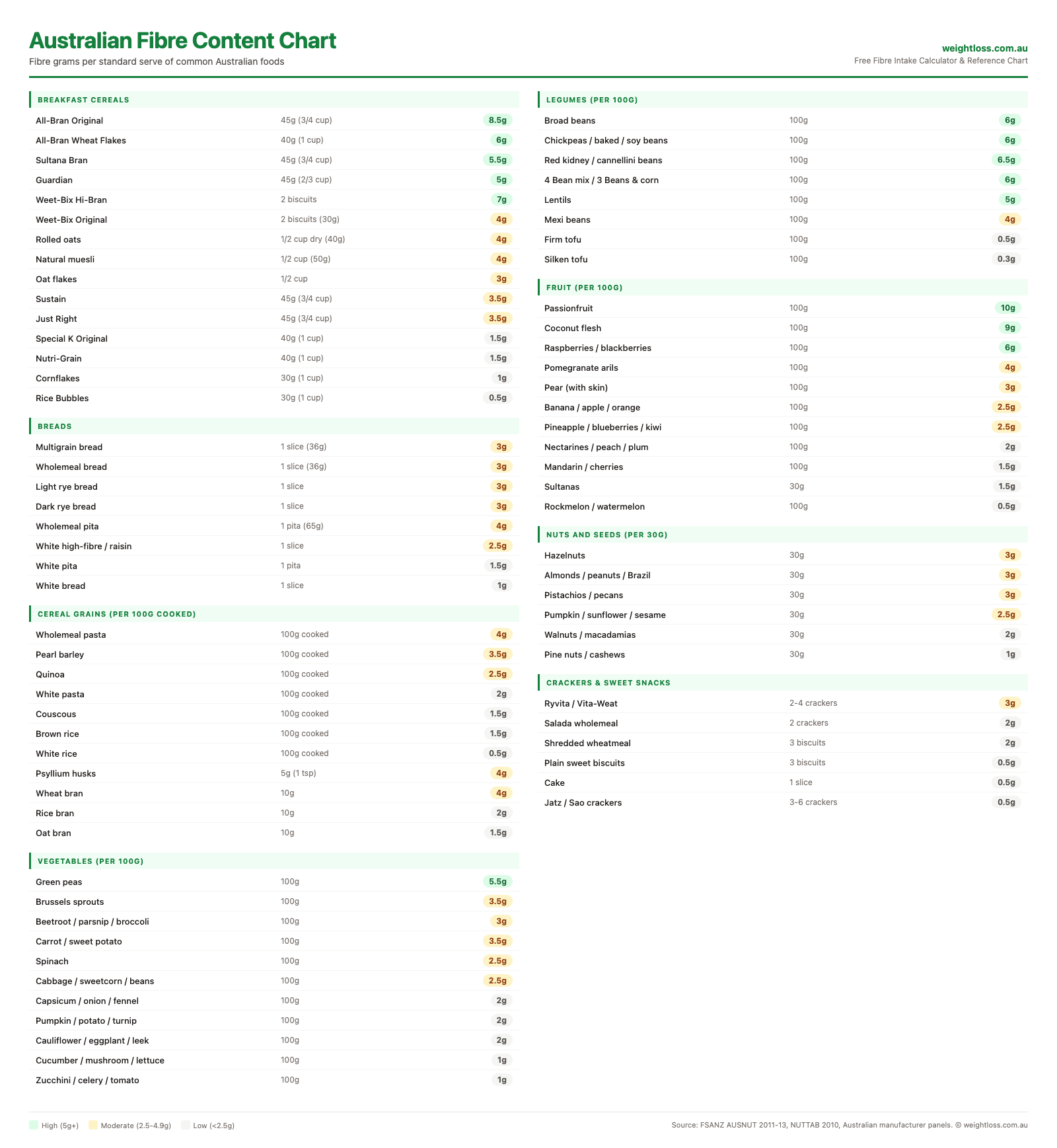
Download the free Australian fibre chart
Save a printable PNG of the full fibre content chart (1600 x 1200) or share it with a friend.